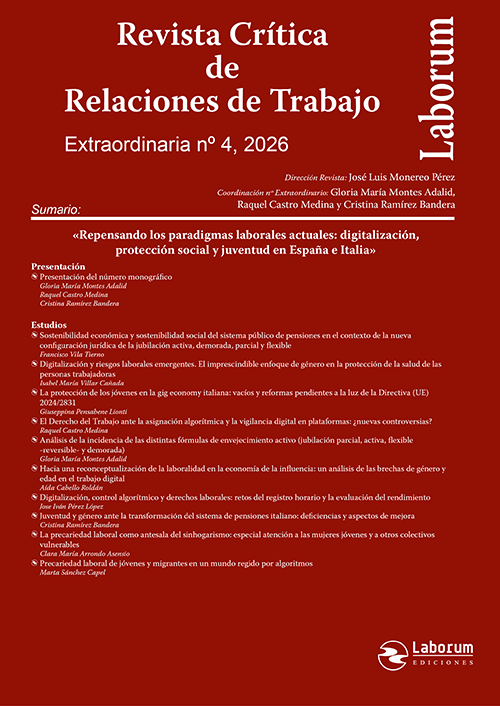
Youth and migrant workers’ labour precarity in an algorithm-driven world
Keywords:
Platform economy, Gig Economy, Migration, Labour Rights, Algorithmic managementAbstract
In the digital age, where information and people are constantly on the move, regulations are needed that address the interplay of these two phenomena. A few decades ago, Digital Labor Platforms (DLPs) began to proliferate, allowing flexible access to the labour market without entry requirements. These characteristics mainly attract workers with fewer opportunities to access other sources of income. In the absence of regulation in this area, people whose activity is carried out through PDLs are completely unprotected and subject to abusive practices such as “incorrect classification” of their employment relationship with the platform; continuous availability; extended working hours; lack of social protection; digital disciplinary control, etc. In response to this situation, Spain passed the so-called “Rider Law” in 2021 and the European Union passed Directive 2024/2831. What improvements does this directive introduce? What does it omit? This publication seeks to understand the socio-economic context and the new legislation framework.
Downloads
References
Alberti, G. y Joyce, S.: “Autualism, Class Composition, and the Reshaping of Worker Organisation in Platform Work and the Gig Economy”, Global Labour Journal, vol. 14, núm. 3, 2023.
Alencar, A. y Camargo, J.: “Spatial imaginaries of digital refugee livelihoods”, Journal of Humanitarian Affairs, vol. 4, núm. 3, 2023.
Alimahomed-Wilson, J., y Reese, E.: “Surveilling Amazon’s warehouse workers: racism, retaliation, and worker resistance amid the pandemic”, Work in the Global Economy, vol.1, núm. 1–2, 2021.
Altenried, M.: “Mobile Workers, Contingent Labour: Migration, the Gig Economy and the Multiplication of Labour”, Environment and Planning A: Economy and Space, vol. 56, núm. 4, 2024.
Azuara Herrera, O., et al.: Conduciendo a través de la economía gig en América Latina: perspectivas y opiniones de los conductores de Uber sobre necesidades, riesgos y oportunidades, Banco Interamericano de Desarrollo, 2025.
Barrial Berbén, C., Dambrosio Clementelli, A., y Santamarina, A.: “Social reproduction and feminized platform labor: Care, domestic work, and migrant Agency in Madrid and Milan”, Digital Geography and Society, Vol. 10, 2026.
Benanav, A.: Automation and the Future of Work, Verso, Londres, 2020.
Berlin Worker Center: „New Cycles of Resistance? A Self-Reflection on the Worker Center Berlin“, Suburban, vol. 12, núm. 1, 2024.
Bhattacharyya, G.: Rethinking racial capitalism: Questions of reproduction and survival, Londres, Rowman & Littlefield, 2018.
Cabello Roldán, A.: “El derecho a la desconexión digital y su incidencia en la prevención de riesgos laborales”, Lan harremanak: revista de relaciones laborales, vol. 50, 2024.
Cabello Roldán, A.: “Reseña de ‘El empleo de los colectivos vulnerables en el marco de la transformación tecnológica: una aproximación jurídico-social’”, Revista de Estudios Jurídico-Laborales y de Seguridad Social (REJLSS), vol. 6, 2023.
Cañada, E., Izcara, C., y Zapata Campos, M. J.: “Putting Fairness into the Gig Economy: Delivery Cooperatives as Alternatives to Corporate Platform”, Societiesvol, 13, núm. 3, 2023.
Cavalcanti Zanforlin, S. y Grohmann, R.: “On-Demand Migrants: Entrepreneurialism, Platformization, and Migration in Brazil”. International Journal of Communication, vol. 16, 2022.
Chun, J.: “Legal liminality: the gender and labour politics of organising South Korea’s irregular workforce”, Third World Quarterly, vol. 30, núm. 3, 2009.
De Genova, N.: ‘‘We are of the connections’: migration, methodological nationalism, and ‘militant research’’, Postcolonial Studies, vol. 16. núm. 3, 2013.
Dhar, D. y Bhattacharya, S.: “Racialized labour, intimate subsidies, and silent cost of social reproduction: The saga of migrant women in India’s gig economy”, Globalizations, 2025.
Ettarfi, K.: “Conceptualizing Labor Agency through Resilience: Practices of Reassembling Work on Domestic Services Platforms”, Elsevier Science Direct Journals, 2024.
Extremera Méndez, F.M.: “La nueva directiva 2024/2831: Hacia la mejora de las condiciones laborales de millones de personas que trabajan para plataformas digitales en la UE”, TransformaW, 2025. Disponible en: https://www.transformaw.com/blog/la-nueva-directiva-2024-2831-hacia-la-mejora-de-las-condiciones-laborales-de-millones-de-personas-que-trabajan-para-plataformas-digitales-en-la-ue/ (última consulta: 21/01/2026).
Fairwork: Fairwork España. Puntuaciones 2024: un largo camino aún por recorrer para la protección del trabajo en la economía de plataforma, Oxford, Reino Unido; Berlín, Alemania, 2024. Disponible en: https://fair.work/en/fw/publications/fairwork-spain-report-2024/.
Froilan Malit, J.: “Defying the “Illiberal” Gig Economy: Coping Strategies of Freelance Domestic Workers in the United Arab Emirates”. Global Labour Journal, vol. 16, núm. 1. 2025.
Gebrial, D.: “Racial Platform Capitalism: Empire, Migration y the Making of Uber in London”, Environment and Planning A: Economy and Space, vol. 56, núm. 4, 2024.
Gómez García, M. y Hospido, L.: “El reto de la medición del trabajo en plataformas digitales”, Artículos Analíticos. Boletín económico 1/2022, Banco de España, 2022.
Gómez Salado, M.A., et al.: El empleo de los colectivos vulnerables en el marco de la transformación tecnológica: una aproximación jurídico-social, Granada, Comares, 2022.
Gómez Santos, I. R.: Inmigración laboral y dignidad, Universitat Jaume I, 2021.
Herrera, E., Urzi Brancati, C., Pesole, A. y Macias, E.: “How to quantify what is not seen? Two proposals for measuring platform work”, JRC Working Papers Series on Labour, Education and Technology, 2019.
Hilgers, L.: “When Your Boss Is an App”, The New York Times, 13 de abril de 2023. Disponible en: https://www.nytimes.com/2023/04/13/magazine/gig-jobs-apps.html (último acceso: enero de 2026).
Holtum, P.J., Irannezhad, E., Marston, G. y Mahadevan, R.: “Business or pleasure? A comparison of migrant and non‐migrant uber drivers in Australia”, Work, Employment and Society, vol.36, núm. 2, 2022.
Hua, M.: “Copy-Paste Paths: Migrants’ Networked Practices in the Platform Economy”, Migration Studies, vol. 13, núm. 3, 2025.
Huijsmans, R.: “The Infrastructuring of Young Adults’ Mobility Trajectories: A Case Study of Highly Educated Migrants in Platform-Mediated Food Delivery Work in the Netherlands”, Journal of Ethnic and Migration Studies, vol. 51, núm. 6, 2025.
Iazzolino, G., & Varesio, A.: “Gaming the System: Tactical Workarounds and the Production of Antagonistic Subjectivities among Migrant Platform Workers in Italy”, Antipode, vol. 55, núm. 3, 2023.
Iazzolino, G.: Digital Economy and Socio-Economic Integration of Migrant Workers in the EU: An Evidence Review and Research Agenda, FIERI – Forum of International and European Research on Immigration, 2023.
Inversi, C.: “Digital caporalato: The Uber Italy Srl case”, Lavoro e Diritto, vol. 35, núm. 2, 2021.
Ivancheva, M.P. y Pla, J. L.: “The double-bind of freedom and economic security: Venezuelan ‘middle class’ migrants in Argentina’s platform economy”, Dialectical Anthropology [Amsterdam], vol. 49, núm. 4, 2025.
Jancewicz, B., y Jóźwiak, I.: “Promises and Perils of Platform Work Availability and Flexibility: A Case Study of Delivery Riders and “Taxi” Drivers in Poland”, Studia Socjologiczne, vol. 256, núm. 1, 2025.
Jaramillo, J.: “«Gig Economy» y migración juvenil: reflexiones sobre la integración de jóvenes latinoamericanos «Riders» en España”, Universitat de Girona, 2025.
Kenney, M., y Zysman, J.: “The Rise of the Platform Economy”, Issues in Science and Technology, vol. 32, núm. 3, 2016.
Leurs, K.: Digital migration, Londres, SAGE Publications, 2023.
Liu, Y. y Huang, H.: “Emotional labor as a situated social practice: Investigating the performance of emotional labor by women migrant workers in China’s platform-based gig economy”, Gender & Society, vol. 39, núm. 2, 2025.
Mathurin, G., et al. “A Fine Balance: Exploring Job Quality in Platform Work Between Migrants and Nonmigrants”, The International Migration Review, 2025.
Mazzucato, V. y Ogden, L. J.: “Transnational youth mobility through trajectories and temporalities”, Journal of Ethnic and Migration Studies, vol. 51, núm. 6, 2025.
McMillan Cottom, T.: “Where Platform Capitalism and Racial Capitalism Meet: The Sociology of Race and Racism in the Digital Society”, Sociology of Race and Ethnicity, vol. 6, núm. 4, 2020.
Mendonça, P., Kougiannou, N. K. y Clark, I.: “Informalization in gig food delivery in the UK: The case of hyper‐flexible and precarious work”. Industrial Relations (Berkeley), vol. 62, núm. 1, 2023.
Moreno Gené, J.: “Presunción legal de laboralidad del trabajo en plataformas digitales de reparto: ¿Y ahora qué?”, Revista de Estudios Jurídico-Laborales y de Seguridad Social (REJLSS), vol. 4. 2022.
Moulier-Boutang, Y.: De la esclavitud al trabajo asalariado, Ediciones Akal, 2006.
Mourad, L. “The ‘daily digital’: (Re)imagining technology in home-based women’s gig work in Egypt”, Global Labour Journal, vol. 16, núm. 1, 2025.
Novo, J.: “Último adiós a La Pájara Ciclomensajería”, Ciclosfera, 2024. Disponible en: https://ciclosfera.com/a/cierra-la-pajara-ciclomensajeria.
Nurpeissov, S. “Migration Processes in the Labor Market Related to the Level of Development of Self-Employed Youth”, Montenegrin Journal of Economics, vol. 21, núm. 3, 2025.
OECD (Organisation for Economic Co-operation and Development) / European Union.: Indicators of Immigrant Integration 2023: Settling InParis, OECD Publishing, 2023.
Pasetti, F., Milano, C., y Soto Aliaga, N.: “Capitalismo de plataforma, trabajo migrante y espacio urbano”, CIDOB Briefings, vol. 67, 2025. Disponible en: https://www.cidob.org/publicaciones/capitalismo-plataforma-trabajo-migrante-espacio-urbano. (Último acceso el 30/01/2016).
Però, D.: “Indie Unions, Organizing and Labour Renewal: Learning from Precarious Migrant Workers”, Work, Employment and Society, vol. 34, núm. 5, 2020.
Pesole, A., Fernández-Macías, E., Urzí, C., y Gómez Herrera, E.: How to quantify what is not seen? Two proposals for measuring platform work, Seville, European Commission, 2019.
Richardson, L.: “Platforms, Markets, and Contingent Calculation: The Flexible Arrangement of the Delivered Meal”, Antipode, vol. 52, núm. 3, 2020.
Rocha Sánchez, F.: “El trabajo a través de las plataformas digitales laborales en España”, Servicio Público de Empleo Estatal, 2023. Disponible en: https://www.sepe.es/HomeSepe/es/que-es-observatorio/Hipatia/cuadernos-mercado-trabajo/revista-cuadernos-mercado-trabajo/detalle-articulo.html?detail=/revista/Cuarta-revoluci-n-industrial-y-su-impacto-en-el-mercado-laboral-y-la-formaci-n/eltrabajoatravesdelasplataformasdigitaleslaboralesenespaa.).
Rodríguez-Piñero Royo, M.: “La Ley Rider dos años después: enseñanzas de una experiencia particular”, Revista de Estudios Jurídico-Laborales y de Seguridad Social (REJLSS), Vol. 7, 2023.
Sánchez-Capel M.: “Empleabilidad y perspectivas laborales de la juventud migrante, refugiados y solicitantes de asilo en España”, Revista de Estudios Jurídico-Laborales y de Seguridad Social (REJLSS), vol. 12, 2025.
Scolari, C.A., Piña, M., GuerreroPico, M.: Communication platforms, workforce and informal learning. White pape of the PLATCOM project, Barcelona, Universitat Pompeu Fabra, 2024.
Srnicek, N.: Platform Capitalism, Cambridge, Polity Press, 2017.
Tandon, A. y Rathi, A.: “Sustaining urban labour markets: Situating migration and domestic work in India’s ‘gig’ economy”, Environment and Planning A: Economy and Space, vol. 56, núm. 4, 2024.
Ticona, J., y Mateescu, A.: “Trusted strangers: Carework platforms’ cultural entrepreneurship in the on-demand economy”, New media & society, vol. 20, núm. 11, 2018.
UNICEF.: “Migration: In 2020, the number of international migrants reached 281 million; 36 million of them were children”, UNICEF, 2021. Disponible en: https://data.unicef.org/topic/child-migration-and-displacement/migration/
Van Doorn, N. y Vijay, D.: “Gig work as migrant work: The platformization of migration infrastructure”, Environment and Planning A: Economy and Space, vol. 56, issue 4, 2024.
Van Doorn, N., et al.: “Migration y Migrant Labour in the Gig Economy: An Intervention”, Work, Employment y Society, vol. 37, núm. 4, 2023.
VV.AA.: Arrival Infrastructures: Migration and Urban Social Mobilities, Meeus, B., Karel, A. y Van Den Broeck, P. (Eds.), Cham, Springer International Publishing, 2019.
Wells, K. J., Attoh, K., y Cullen, D.: ““Just-in-Place” labor: Driver organizing in the Uber workplace”, Environment and Planning A: Economy and Space, vol. 0, núm. 0, 2020.
Yin, S.: “Situating Platform Gig Economy in the Formal Subsumption of Reproductive Labor: Transnational Migrant Domestic Workers and the Continuum of Exploitaion and Precarity”, Capital & Class, vol. 48, núm. 1, 2024.
Ypi, L.: Fronteras de clase. Desigualdad, Migración y Ciudadanía en el Estado Capitalista, Anagrama, Fuentes, A. (trad.), 2025.
Zhang, H. y Liu, K.: “Can a voluntarist approach to social security extend protection to gig workers? Evidence from the platform-based food-delivery sector in China”, Journal of Industrial Relations, vol. 67, núm. 1, 2025.
Zhou, Y. y Pun, N.: “Affording Worker Solidarity in Motion: Theorising the Intersection between Social Media and Agential Practices in the Platform Economy”, New Media & Society, vol. 26, núm. 8, 2024.