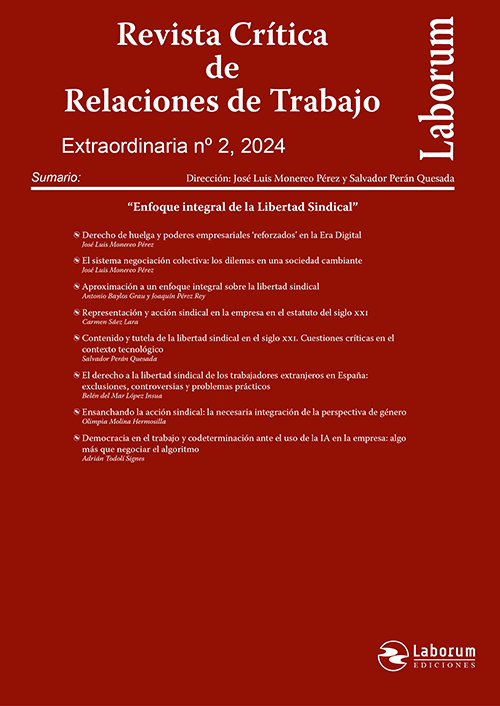
Democracy at work and codetermination in the use of AI in the company: more than negotiating the algorithm
Keywords:
Worker participation, co-determination, AI, collective bargaining, freedom of association, new technologies, union response to AIAbstract
The use of artificial intelligence to make decisions affecting workers is challenging the guarantee of labor rights. It has been proposed that collective bargaining should regulate the use of AI. This paper argues that collective bargaining as currently regulated may be insufficient to achieve this end. This paper analyzes the reasons for this inadequacy. Based on this analysis, it is proposed that it is necessary to reform worker participation in the company to grant co-determination rights to representatives. Specifically, recent initiatives in European countries in the area of IA and employee participation are studied and concrete proposals are made to address the current shortcomings of the participation system in the area of joint regulation of IA.
Downloads
References
Adams, J.S.: “Inequity in social Exchange”, en VV.AA.: Advances in experimental social psychology, Berkowitz L.R., (ed.), vol. 2, New York, Academic Press, 1965, pp 267-299.
Adams Z.: Legal concept of work, Oxford University Press, 2022.
Adams, Z. y Wenckebach, J.: “Collective regulation of algorithmic management”, European Labour Law Journal, vol. 14 (2), 2023, pp. 211-229.
Alonso Olea, M.: “La cogestión en los países anglosajones”, en AAVV.: Diecisiete lecciones sobre participación de los trabajadores en la empresa, Universidad de Madrid, Facultad de Derecho (eds), Madrid, 1967.
Ball, K.: “Workplace surveillance: An overview”, Labor History. 51, pp. 87-106.
Bosch, G. y Schmitz-Kießler, J.: “Shaping Industry 4.0 - an experimental approach developed by German trade unions”, Transfer European Review of Labour and Research, vol. 26 (2), 2020, pp. 189-206.
Bramucci, A. y Zanfei, A.: “The governance of offshoreng and its effects at home. The role of codetermination in the international organization of German firms”, Economia e Politica Industriale: Journal of Industrial and Business Economics, 42 (2), 2015, pp. 217-244.
Collins, P. y Atkinson, J.: “Worker voice and algorithmic management in post-Brexit Britain”, Transfer: European Review of Labour and Research, Vol. 29 (1), 2023, pp. 37-52.
Christiano, T.: “Self-determination and the human right to democracy”, en VV.AA.: Philosophical foundations of Human Rights, Cruft, R., Liao, S.M. y Renzo, M. (eds) Oxford University Press, 459-481.
Dahl, R.: A preface to Economic Democracy, University of California Press, CA, 1985.
Delfanti, A., Radovac, L. y Walker, T.: The Amazon panopticon: A guide for workers, organizers and policymakers, Report for UNI Global, 2021.
De Spiegelaere, S., Hoffmann, A., Jagodzinski, R. y Lafuente, S.: “Democracy at work”, en VV.AA.: Benchmarking working Europe 2019, Jepsen, M (ed), Bruselas, ETUI, 2019, pp. 67-89.
De Stefano V.: “Negotiating the algorithm: Automation, artificial intelligence, and labor protection”, Comparative Labour Law and Policy Journal, 41 (1), 2020, pp. 15-46.
De Stefano, V. y Taes, S.: “Algorthmic Management and Collective Bargaining”, Transfer: European Review of Labour and Research, vil. 29(1), 2023, pp. 21-36.
Doellgast, V., Wagner, I. y O’Brady, S.: “Negotiating limits on algorithmic management in digitalised services: cases from Germany and Norway”, Transfer: European Review of Labour and Research, vol. 29(1), 2023, pp. 105-120.
Dzieza, J.: “How hard will the robots make us work?”, The Verge, 27 de febrero de 2020.
Fauver, L. y Fuesrst, M.: “Does good corporate governance incude employee representation? Evidence from German corporate boards”, Journal of Financial Economics, 82, 673-710.
Fernandez González, V.: “Cogestión, grados y esferas (teoría general)”, en VV.AA.: Diecisiete lecciones sobre participación de los trabajadores en la empresa, Universidad de Madrid, Facultat de Derecho (ed), Madrid 1967, pp. 73-84.
Ginès i Fabrellas, A.: “La gestión algorítmica del trabajo: nuevos retos jurídicos, tecnológicos y éticos”, XXXII Congreso Anual de la Asociación Española de Derecho del Trabajo y de la Seguridad Social, Alicante, 26 y 27 de mayo de 2022, pp. 295-320.
Goerlich Peset, J.M.: “El acuerdo Marco Europeo sobre Digitalización”, Documentación Laboral, 122, 2021, 49-57.
Goerlich Peset, J.M.: “Representación del personal y protección de datos. Criterios interpretativos”, Labos, 2024.
Gómez Grodillo, R.: “Algoritmos y derecho de información de la representación de las personas trabajadoras”, Temas Laborales, 158, 2021, pp. 161-182.
Gumbrell-McCormick, R. y Hyman, R.: Trade Unions in Western Europe: Hard Times, Hard Choices, Oxford University Press, 2013.
Heredero Higueras, M.: La Ley Orgánica 5/1992 de Regulación del Tratamiento Automatizado de los Datos de carácter Personal: comentario y textos. Madrid: Tecnos 1996.
Klengel, E. y Wenckebach, J.: “Artificial intelligence, Work, Power Imbalance and Democracy - Why Co-Determination is Essencial”, Italian Labour Law E-journal, 14, 2021.
Kraft K.: “Codetermination as a strategic advantage?”, International Journal of Industrial Organization, 19, 2001, pp. 543-566.
Kryzywdzinski, M., Grest, D. y Butollo, F.: “Promoting human-centred AI in the workplace. Trade unions and their strategies for regulating the use of AI in Germany”, Transfer: European Review of Labour and Research, vol. 29 (1), 2023, pp. 53-70.
Landa Zapirain, J.P.: “Agotamiento del modelo español de doble canal de representación para una eficiente gestión del cambio en la empresa: La co-determinación como posible solución”, Doc. Labor. nº 109, 2017, pp. 19-58.
Lucas Murillo de la Cueva, P.: Informática y protección de datos personales (estudio sobre la Ley Orgánica 5/1992 de Regulación del Tratamiento Automatizado de los Datos de Carácter Personal), Madrid, Colección Cuadernos y Debates nº 43, Centro de Estudios Políticos y Constitucionales, Ministerio de la Presidencia, 1993.
Lucher C.: “How Amazon automatically tracks and fires warehouse workers for “productivity”. The Verge, 2019.
Mercader Uguina, J.R.: “La gestión laboral a través de algoritmos”, XXXII Congreso Anual de la Asociación Española de Derecho del Trabajo y de la Seguridad Social, Alicante, 26 y 27 de mayo de 2022, pp. 253-294.
Mercader Uguina, J.R.: “Hacia una democracia digital en la empresa”, LABOS Revista de Derecho del Trabajo y Protección Social, 4 (2), 2023, pp. 4-21.
Moore, P.V.: The quantified self in precarity. Work, technology and what counts, New York, Routledge, 2018.
Moore, P.V.: Humans and machines at work: monitoring, surveillance and automation in contemporary capitalism. London, Palgrave Macmillan, 2018.
Moore, P.V.: Data subjects, digital surveillance, AI and the future of work. Brussels: European Parliament Science and Technology Office, 2020.
Nienhüser, W.: “Work councils”, en VV.AA.: Handbook of research on employee voice, Wilkinson, A., Donaghey, J., Dundon, T. y Freeman, R. B. (eds), Cheltenham, Elgar, 2020, pp. 247-263.
Palmer, A.: “Amazon is using AI-equipped cameras in delivery vans and some drivers are concern about privacy” CNBC, 3 de febrero de 2021.
Prassal, J.: “What if Your Boss Was an Algorithm? The Rise of Artificial Intelligence at Work”, Comparative Labor Law & Policy Journal 41(1), 2020, pp. 123-153.
Rego, K.: “Works councils and the digitalisation of manufacturing: Opportunity or threat for their power position?”, Economic and Industrial Democracy, vol. 43 (4), 2022, pp. 1911-1933.
Rani, U., Pesole, A. y González, I.: Algorithmic management practices in regular workplaces: case studies in logistics and healthcare, Publications Office of the European Union, Luxembourg, 2024, https://data.europa.eu/doi/10.2760/712475, JRC136063.
Rivas Vallejo, M P.: Discriminación algorítmica en el ámbito laboral: perspectiva de género e intervención, Aranzadi, 2022.
Rodríguez Fernández, M.L.: “La participación de las personas trabajadoras en la gobernanza de la transición digital: las experiencias de la Unión Europea y de España”, Revista de Derecho Social, 101, 2023, pp. 107-140.
Rogers, B.: “The law and political economy of workplace technological change”, Harvard Civil Rights- Civil Liberties Law Review (CR-CL), Vol. 55, 2019, pp. 531-584.
Ronaldsson, B., Alasoini, T., Berglund T, y Dølvik J. E.: Digital Transformations of Traditional Work in the Nordic Countries. Nordic Council of Ministers, 2020.
Sáez Lara, C.: “Gestión algorítmica empresarial y tutela colectiva de los derechos laborales”, Cuadernos de Relaciones Laborales, 40 (2), 2022, pp. 283-300.
Sanchez-Monedero, J., Dencik, L., Edwards, L.: “What does it mean to “solve” the problem of discrimination in hiring?”, FAT* ‘20: Proceedings of the 2020 Conference on Fairness, Accountability, and Transparency, 2020, pp. 458-468., Disponible en, https://dl.acm.org/doi/abs/10.1145/3351095.3372849.
Solon, O.: “Big Brother isn´t just watching: workplace surveillance can track your every move”, The Guardian. (6 de noviembre de 2017). Recuperado de: ;.
The Week staff.: “The rise of workplace spying”, Week, 2015. Recuperado de https://theweek.com/articles/564263/rise-workplace-spying (accedido 20/07/2022).
Todolí Signes, A.: “La gobernanza colectiva de la protección de datos en las relaciones laborales: big data, creación de perfiles, decisiones empresariales automatizadas y los derechos colectivos”, Revista de Derecho Social, 84, 2018, pp. 69-88.
Todolí Signes, A.: “En cumplimiento de la primera Ley de la robótica: Análisis de los riesgos laborales asociados a un algoritmo/inteligencia artificial dirigiendo el trabajo”, Labour & Law Issues, 5 (2), 2019.
Todolí Signes, A.: Regulación del trabajo y política económica. De cómo los derechos laborales mejoran la economía. Aranzadi, 2021.
Todolí Signes, A.: “Cambios normativos en la Digitalización del Trabajo: Comentario a la “Ley Rider” y los derechos de información sobre los algoritmos”, Iuslabor, 2, 2021, pp. 28-65.
Todolí Signes, A.: Algoritmos productivos y extractivos, Aranzadi, 2023.
Van den Broek, E., Sergeeva, A. y Huysman, M.: “When the machine meets the expert: An ethnography of developing IA for hiring”, MIS Quaterly, 45(3), 2021, pp. 1557-1580.
VV.AA.: Heat Stress and On-Demand work: The experience of food delivery and courier cyclists. Climate Justice Centre at University of Technology, Sydney, 2019. Disponible en: ;.
VV.AA.: “It takes two to code: a comparative analysis of collective bargaining and artificial intelligence”, Transfer: European Review of Labour and Research, vol. 29(1), 2023, pp. 87-104.