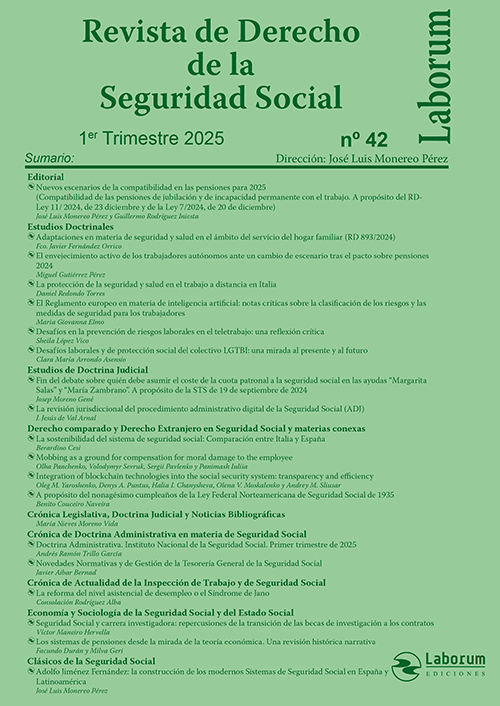
Pension systems from the perspective of economic theory. A narrative historical review
Keywords:
Pension system, welfare, income distribution, economic growthAbstract
Modern pension systems originated in the early twentieth century, but it was not until the 1960s that leading figures in economic theory started to debate in the academic sphere what the economic effects of pension systems would be. They focused on the effects on welfare, income distribution, and economic growth. This article reflects the main arguments related to each of these points.
Downloads
Article page views
History retained by PKP. Accesses are not unique people and do not guarantee a completed download. Data through: 2026-11-05.
Downloads
References
Aaron, H. (1966). The social insurance paradox. Canadian Journal of Economics and Political Science/Revue canadienne de economiques et science politique, 32(3), 371-374.
Ackley, W. (1971). The role of expectations in economic policy. Journal of Money, Credit and Banking, 3(3), 439-457.
Auerbach, A. J., & Kotlikoff, L. J. (1987). Dynamic fiscal policy. Cambridge University Press.
Banco Mundial (1994). Envejecimiento sin crisis. Oxford University Press, USA.
Barro, R. J. (1974). Are government bonds net wealth?. Journal of political economy, 82(6), 1095-1117.
Barro, R.J. (1978), The Impact of Social Security on Private Saving (American Enterprise Institute for Public Policy Research, Washington, DC).
Beveridge, W. (1942). Social insurance and allied services. UK.
Boskin, M. J. (1977). Social security and retirement decisions. Economic inquiry, 15(1), 1-25.
Buchanan, J. M. (1968). Social insurance in a growing economy: A proposal for radical reform. National Tax Journal, 21(4), 386-395.
Bureau of Labour Statisticts (1916). Social insurance in Germany. Monthly Review of the U.S. Bureau of Labor Statistics, US Department of labour. 2 (5), pp. 71-78.
Cagan, P. (1965). The Effect of Pension Plans on Aggregate Savings: Evidence from a Sample Survey: National Bureau of Economic Research. Columbia University Press.
Darby, M. R. (1979), The Effects of Social Security on Income and the Capital Stock (American Enterprise Institute, Washington, DC).
Feldstein, M. (1974). Social security, induced retirement, and aggregate capital accumulation. Journal of political economy, 82(5), 905-926.
Feldstein, M. (1977). Social security and private savings: international evidence in an extended life-cycle model. In The Economics of Public Services: Proceedings of a Conference held by the International Economic Association at Turin, Italy (pp. 174-205). Palgrave Macmillan UK.
Feldstein, M. (1980). International differences in social security and saving. Journal of Public Economics, 14(2), 225-244.
Feldstein, M. (1982). Social security and private saving: reply. Journal of Political Economy, 90(3), 630-642.
Feldstein, M. (1983). Social security benefits and the accumulation of pre-retirement wealth. In The Determinants of National Saving and Wealth: Proceedings of a Conference held by the International Economic Association at Bergamo, Italy (pp. 3-23). Palgrave Macmillan UK.
Friedman, M. (1962). Capitalism and freedom. Chicago: University of Chicago Press
Friedman, M. & Cohen, W. (1972). Social Security: Universal or Selective. Washington, D.C.: American Enterprise Institute.
Katona, G. (1964). Private Pensions and Individual Savings. Ann Arbor: Survey Research Center, Institute for Social Research, Univ. Michigan.
Leimer, D. R., & Lesnoy, S. D. (1982). Social security and private saving: New time-series evidence. Journal of Political Economy, 90(3), 606-629.
Lerner, A. P. (1959). Consumption-loan interest and money. Journal of Political Economy, 67(5), 512-518.
Lilien, D. M. (1979). The Labor Force Participation of Older Workers. Department of Economics, University of California.
Mesa-Lago, C. (2006). Private and public pension systems compared: An evaluation of the Latin American experience. Review of Political Economy, 18(3), 317-334.
Mesa-Lago, C. (2021). Evaluación de cuatro décadas de privatización de pensiones en América Latina (1980-2020): Promesas y realidades. Fundación Friedrich Ebert en República Dominicana.
Modigliani, F. (1986). Life cycle, individual thrift, and the wealth of nations. Science, 234(4777), 704-712.
Modigliani, F., & Sterling, A. (1983). Determinants of private saving with special reference to the role of social security—cross-country tests. In The Determinants of National Saving and Wealth: Proceedings of a Conference held by the International Economic Association at Bergamo, Italy (pp. 24-55). Palgrave Macmillan UK.
Monereo Pérez, JL. (2015). William Henry Beveridge (1879-1963): La construcción de los modernos sistemas de seguridad social. Revista de derecho de la seguridad social Laborum N° 4, p. 279-305.
Ortiz, I., Durán-Valverde, F., Urban, S., Wodsak, V., & Yu, Z. (2019). La privatización de las pensiones: tres décadas de fracasos. El trimestre económico, 86(343), 799-838.
Samuelson, P. A. (1958). An exact consumption-loan model of interest with or without the social contrivance of money. Journal of political economy, 66(6), 467-482.
Samuelson, P. A. (1975). Optimum social security in a life-cycle growth model. International economic review, 539-544.
Westerhout, E., Meijdam, L., Ponds, E., & Bonenkamp, J. (2022). Should we revive PAYG? On the optimal pension system in view of current economic trends. European Economic Review, 148, 104227.