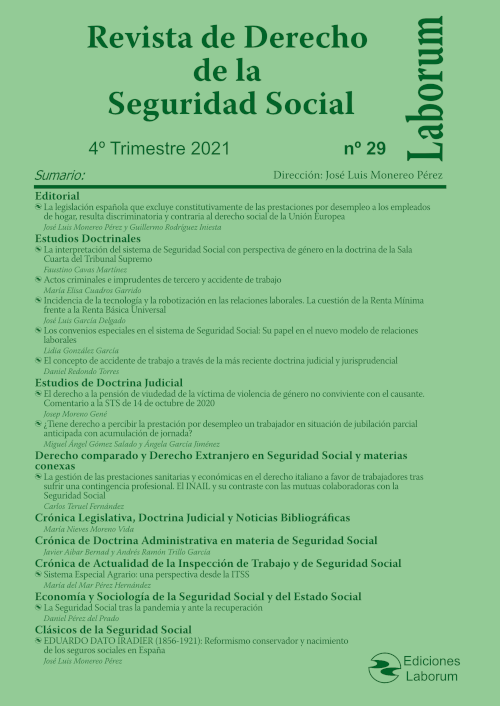
Incidence of technology and robotisation in labour relations. The issue of Minimum Income versus Universal Basic Income
Abstract
Technology and its implications for the robotisation of production processes are radically transforming the field of labour relations, including the personnel structure within the civil service, and this impact will be even greater in the future. It is debated whether this robotisation will reduce the number of jobs, or whether this number will grow. To combat poverty levels of populations with very limited or no resources, there are two possible remedies: Minimum Income and Universal Basic Income. The alternative to Minimum Income, with a broader scope, is the Universal Basic Income, which has been the subject of several national implementation experiences, but in small areas and for short periods of time.
This article analyses the impact of robotisation in the labour sphere and within Public Administration, the pros and cons of Minimum Income and Basic Income, focusing especially on the latter, and advocates carrying out a trial of a Universal Basic Income in Spain in order to be able to decide on its implementation with contrasted arguments.
Downloads
Article page views
History retained by PKP. Accesses are not unique people and do not guarantee a completed download. Data through: 2026-11-05.
Downloads