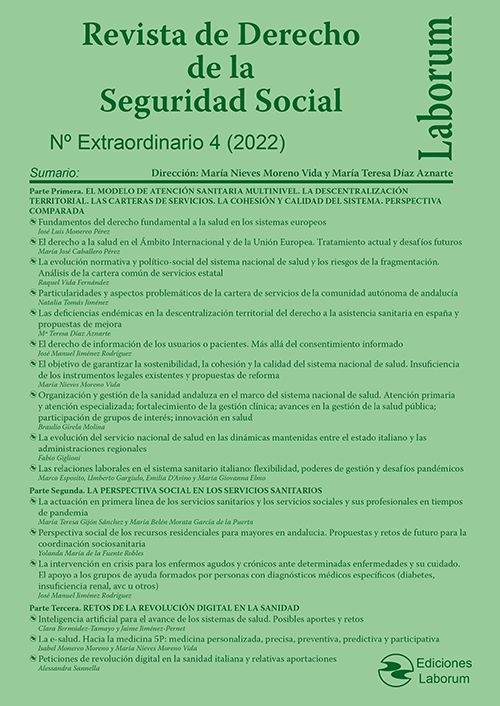
The right to health at the international level and at the european union level. Current treatment and future challenges
Abstract
Within the international society, the right to health promotion and protection has an organization specialized in ensuring its compliance (WHO), And its consecration as a fundamental right inherent to the dignity of every human being is reflected in various normative texts attributing to States parties a series of duties and responsibilities that emphasize the proactive role that they must take in order to achieve their full effectiveness. The outbreak of the health crisis resulting from the COVID-19 pandemic has had a negative impact on the fulfillment of all these objectives in the context of even more fragile and weakened health systems and has highlighted the shortcomings of the International Health Regulations of 2005. The Community rules have been limited to the coordination of national health policies, not to their harmonization, and the possibility of establishing a European health care system, common to all the Member States of the Union, has been ruled out. In addition to the route of coordination regulations, the current Directive 2011/24/EU, of 9 March, incorporated into the Spanish legal system through RD 81/2014, of 7 February, It seeks to give every EU citizen the right to receive safe, quality health care in any Member State, not only in the public but also in the private sphere, and the right to obtain reimbursement from its State of Insurance for health costs arising from such assistance abroad, under an alternative procedure to that provided for in the Coordination Regulations. Following the COVID-19 pandemic, the EU seems to have taken up firmly the objective of building a strong European Health Union.
Downloads
Article page views
History retained by PKP. Accesses are not unique people and do not guarantee a completed download. Data through: 2026-11-05.
Downloads