
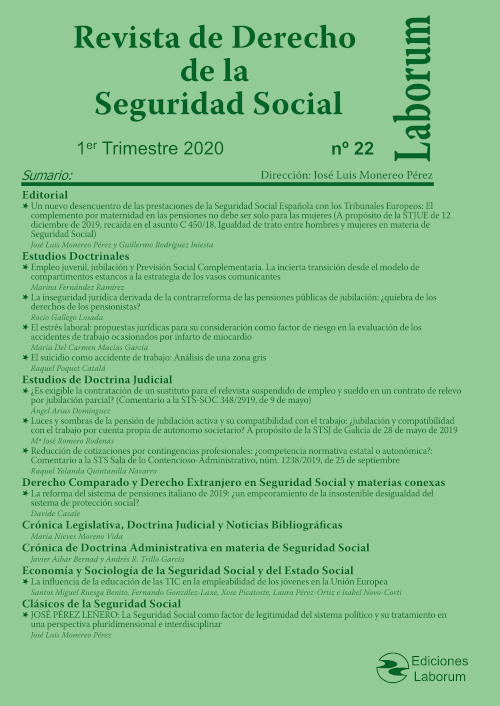
The influence of ICT education on the employability of young people within the European Union
Keywords:
youth employment, ICT, education, Internet skills, computer skillsAbstract
The European Union has high rates of youth unemployment, especially within the countries most affected by the economic crisis. These unemployed young people usually have high levels of knowledge and skills in the fields of information and communication technologies (ICT), as they belong to the generation of "millennials" or "digital natives". However, they struggle to find employment and at times become discouraged. This paper analyses the influence of ICT knowledge, considering formal and informal education, the real skills acquired online and through the use of computers, and their impact on youth employment rates From the research which forms the basis of this study, one of the most appropriate methodologies to evaluate these relationships is applied: a model of structural equations, which allows for causal relations to be established between the knowledge of ICT skills and the three dependent variables or variables which are considered to be explainable through the knowledge or acquirement of skills in ICT. This analysis has been carried out within the European Union, for young people between 15 and 24 years old.Downloads
351
registered galley accesses
Last 12 months: 101
PDF: 351
· HTML: 0
· Other formats: 0
Article page views
1974
registered views
Last 12 months: 1617
History retained by PKP. Accesses are not unique people and do not guarantee a completed download. Data through: 2026-11-05.
Downloads
Download data is not yet available.
Downloads
Published
2020-03-31
Issue
Section
Economía y Sociología de la Seguridad Social y del Estado Social
How to Cite
The influence of ICT education on the employability of young people within the European Union. (2020). Revista de Derecho de la Seguridad Social, Laborum, 22, 255-272. https://revista.laborum.es/index.php/revsegsoc/article/view/404